


Cybersecurity Checklist for South African SMEs: 7 Security Controls to Review Before Year-End

If your business has not reviewed its cybersecurity controls in the last 12 months, there is a good chance you have security gaps you are unaware of. Recent Kaspersky research found that 78% of South African SMBs experienced at least one cybersecurity incident in the past year, with social engineering, phishing, stolen credentials, and business email compromise among the most common threats. Reviewing a small number of critical controls before year-end can significantly reduce your risk and improve your resilience.
When This Is the Right Choice / When It Isn’t
This checklist is designed for South African businesses with between 10 and 250 employees that rely on email, cloud applications, Microsoft 365, customer data, and internet-connected devices.
It is particularly relevant if:
- Your business has grown during the last year.
- Staff work remotely or in a hybrid environment.
- You have never conducted a formal cybersecurity review.
- You need to comply with POPIA requirements.
If you already have a dedicated security team, annual penetration testing programme, and documented cyber governance framework, this checklist may simply act as a validation exercise.
The 7-Step Cybersecurity Checklist
1. Is Multi-Factor Authentication Enabled Everywhere?
Passwords alone are no longer sufficient protection.
According to Kaspersky’s 2026 South African SMB research, weak or stolen credentials remain one of the most common causes of security incidents. Cybercriminals increasingly purchase compromised passwords from dark web marketplaces or obtain them through phishing attacks.
Review:
- Microsoft 365 accounts
- VPN access
- Remote desktop access
- Cloud applications
- Administrative accounts
If MFA is not enabled everywhere possible, this should be your highest priority.
2. Have You Tested Your Backups Recently?
Many businesses know backups are running.
Far fewer know whether recovery actually works.
A modern backup strategy should include:
- Daily backups
- Offsite copies
- Recovery testing
- Ransomware protection
Businesses relying on backup reports without recovery testing are operating on assumptions rather than evidence.
3. Do You Know Which Employees Represent the Highest Risk?
Cybersecurity is increasingly becoming a people challenge rather than a technology challenge.
ASG’s Human Risk Management approach focuses on measuring employee risk through training, phishing simulations, and behavioural monitoring rather than relying solely on annual awareness sessions.
Ask yourself:
- Could employees identify a phishing email?
- Would finance staff recognise payment fraud?
- Are executives prepared for impersonation attacks?
If you do not know the answers, you have an unmanaged risk.
4. Are Your Microsoft 365 Accounts Properly Secured?
Many SMEs assume Microsoft 365 is secure by default.
In reality, security depends on how it is configured and managed.
Review:
- MFA status
- Administrator privileges
- External sharing permissions
- Conditional access policies
- Suspicious sign-in monitoring
Microsoft 365 is often one of the most targeted systems within an SME environment.
5. Are All Devices Receiving Security Updates?
Attackers frequently exploit known vulnerabilities that already have available fixes.
Review:
- Windows updates
- Application updates
- Firewall firmware
- Network infrastructure
- Endpoint protection status
If devices are not being monitored and updated consistently, vulnerabilities can remain exposed for months.
6. Do You Have Visibility Into Shadow IT?
Shadow IT refers to software and cloud services employees use without IT approval.
Recent Kaspersky research highlights the growing use of unauthorised tools, including AI applications, within SMB environments. Attackers are increasingly disguising malware as legitimate AI tools and services.
Review:
- File sharing platforms
- AI tools
- Password managers
- Browser extensions
- Collaboration applications
You cannot secure systems you do not know exist.
7. Do You Have an Incident Response Plan?
Most businesses spend time planning for operational disruptions but never document how they would respond to a cyber incident.
An effective incident response plan should answer:
- Who makes decisions?
- Who contacts customers?
- Who communicates with suppliers?
- How are systems recovered?
- When are legal obligations triggered under POPIA?
When an incident occurs, clarity saves time.
Costs or Effort Ranges
For a typical South African SME, improving these controls generally involves:
| Activity | Typical Cost Range |
|---|---|
| MFA rollout | Low cost to included in Microsoft licensing |
| Security awareness training | R49–R79 per user per month |
| Managed backup solution | R50–R250 per user per month |
| Cybersecurity assessment | R5,000–R30,000+ |
These figures are estimates and vary depending on user count, infrastructure complexity, compliance requirements, and existing security maturity.
Cybersecurity Checklist at a Glance
Short on time? The infographic below summarises the seven cybersecurity controls every South African SME should review before year-end. Use it as a quick reference, then continue reading for practical guidance on how to assess and improve each area.
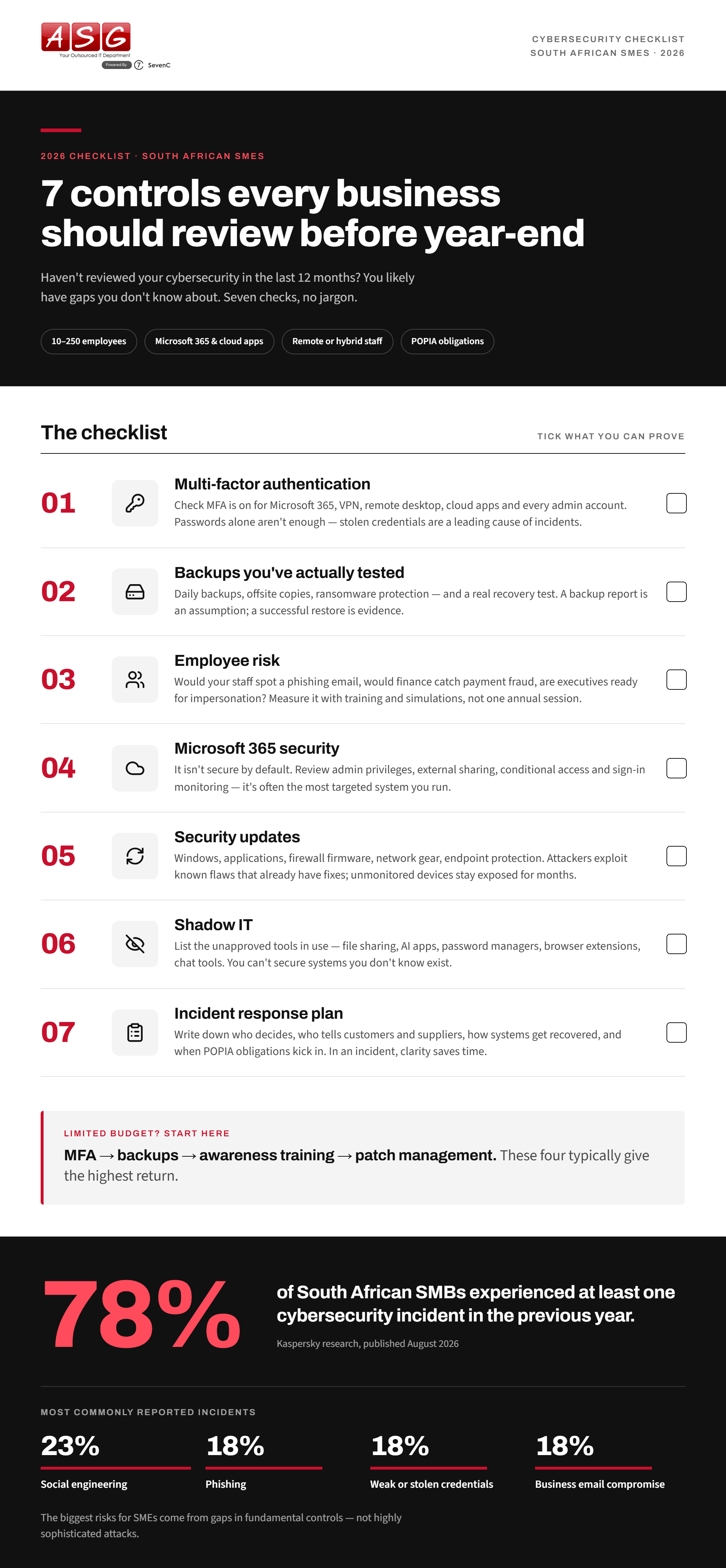
The checklist provides a high-level overview, but each control plays a different role in reducing cyber risk. Let’s look at what each one means in practice and how to assess whether your business is adequately protected.
Proof
According to Kaspersky research published in August 2026, 78% of South African SMBs experienced a cybersecurity incident during the previous year. The most commonly reported incidents were social engineering (23%), phishing (18%), weak or stolen credentials (18%), and business email compromise (18%). These findings reinforce that the greatest risks facing SMEs often stem from gaps in fundamental security controls rather than highly sophisticated attacks.
Yes. According to Kaspersky’s 2026 research, cybercriminals increasingly use the same attack techniques against SMBs as they do against larger organisations. Smaller businesses are often viewed as easier targets because they typically have fewer dedicated security resources.
POPIA does not prescribe specific technologies. However, it requires organisations to implement reasonable technical and organisational safeguards to protect personal information.
Start with MFA, backups, employee awareness training, and patch management. These controls typically provide the highest return on investment.
At least annually, and whenever there is significant business growth, a technology change, or a security incident.
No. Training is important, but it should be supported by technical controls, monitoring, access management, and ongoing risk assessment.
Share this article on:
Require IT company assistance or need more information?
OR
Receive our latest it articles
More Articles
Cybersecurity Checklist for South African SMEs: 7 Security Controls to Review Before Year-End
Cybersecurity Checklist for South African SMEs: 7 Security Controls to Review Before Year-End If your …
Human Risk Management for South African SMEs: How to Reduce the Cybersecurity Risk Technology Can’t …

How AI Is Changing the Workplace for SMEs in 2026 AI is no longer future …